News
“There will only be more work for artists”: Alexander Afanasyev, director at Parovoz studio, on technology, inspiration, and the animated film Beyond
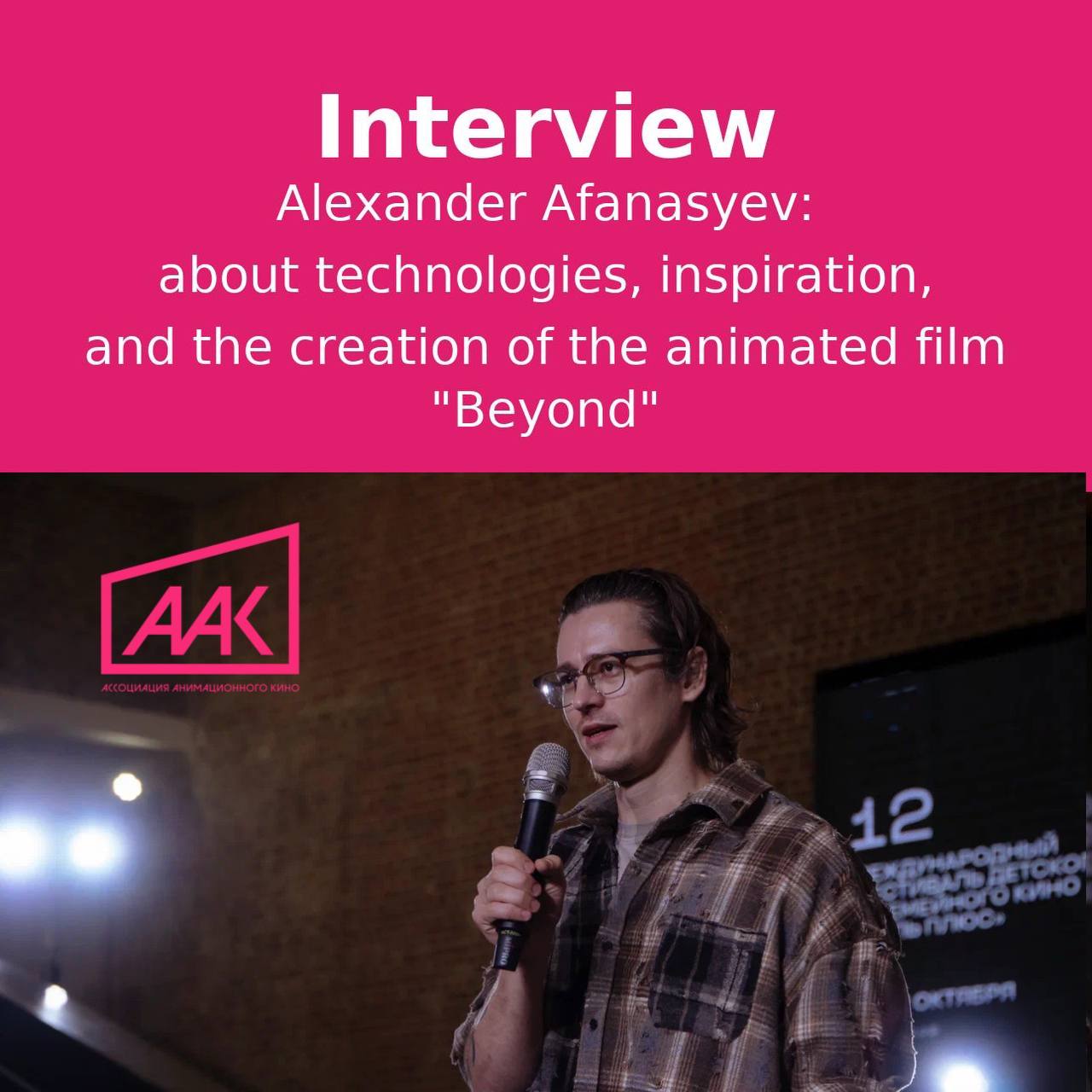
The animation industry is undergoing change — technologies are becoming an increasingly active part of the creative process. Where is the boundary between the machine and the artist? Director and production supervisor at Parovoz studio, Alexander Afanasyev, will speak about this on October 27 at a panel discussion at the Big Cartoon Festival. His debut film Beyond was included in the festival’s special program and the longlist for the Golden Eagle Award. In this interview, we discuss how personal stories are born, why it’s important not to fear new tools, and what awaits animation “on the other side” of technology.
— Alexander, your directorial debut, the animated film Beyond, entered the Big Cartoon Festival’s special program and the Golden Eagle longlist. Where did this story begin for you personally?
It began with a very simple and sincere request I made to Zhenya Golovin (Evgeny Golovin, creative director at Parovoz): “I want to try myself as a director — I feel ready!”
For me, any new step in life is always “knocking on a new door.” And I can say with certainty: this approach works every time. That’s how I started in production, that’s how I became a supervisor, and that’s how I’m now stepping into directing with my first film.
— Before Beyond, you worked in production for more than ten years. At what point did the idea of moving into directing and author animation appear?
Since childhood, I’ve always loved animation and dreamed of making it. I started, one might say, in an old-fashioned way — I asked to intern at a studio where my university teacher worked, just to touch something beautiful. And then everything unfolded.
With every step in my work and life, I wanted more influence over the animated film. At first I thought that power belonged to the supervisor — but after several years in that role, I realized that true creative power belongs to the director.
I came to auteur animation almost accidentally, without fully understanding the depth of the art — and once I touched it, I fell in love.
— A production supervisor sees how ideas collide with deadlines and the realities of workflow. When you became a director, did this experience help or interfere with creative freedom?
Oh, it’s an amazing experience! I would never give up supervision — let there be two Sashas united in one.
I believe every director must understand the realities of production. Only then is there a chance to create something truly worthwhile. As one of my teachers once said: “Creativity is born in limitations.”
— You’ve already presented the film at several Russian and international festivals — in Voronezh, Kazan, and Tyumen. How do audiences — children and adults — react? Any story or feedback that especially stayed with you?
The one I remember most was a request from a woman in Voronezh (at the Multpraktika festival): “Please make films a bit lighter, a bit kinder…”
In general, I really enjoy talking with viewers — answering their questions, discussing the film or other favorite movies. This is what we live for — to leave something behind. And I feel that with Beyond, we managed to do that.
— Today the industry is actively discussing the role of artificial intelligence. How do you personally see it — a tool, a new creative opportunity, or a threat to the artist?
I would say people are talking about it even too actively. Unfortunately, people tend to exaggerate benefits, risks, hopes, and fears — that creates noise and confusion.
I’d recommend everyone — myself first of all — to observe more and avoid rushing to absolute conclusions.
You can’t run from progress, regardless of your attitude toward it.
My prediction is that in the end, there will actually be more work for people — and for artists in particular. We’ve seen something similar during the Industrial Revolution. But before that happens, the process may be quite turbulent.
— In your opinion, can AI become a useful assistant in auteur animation?
Indirectly — absolutely. Whenever I discuss promotion strategy with AI or go through dozens of title options, it’s already assisting in auteur animation, right?
As for direct use — script co-writing or visual development — each author will choose their own approach. Some will use it actively.
Personally, for my next project, I don’t yet see a direct role for AI. Although, I’ll admit, I’m already discussing the setting of the film with it and using AI for research.
— And finally, what are you working on now, and what themes would you like to explore in future projects?
Right now, I’m in a period of reflection. I have a detailed synopsis on my desk that I’m slowly digesting and transforming.
In general terms, I want to turn to something timeless: the theme of fathers and children, generational conflict, and that exact moment when the fledgling leaves the nest.
This, to me, is the beauty of auteur cinema — speaking about truly important things. There are not many of them in the world, you can count them on your fingers.
The important thing is to express them in a way no one has done before.